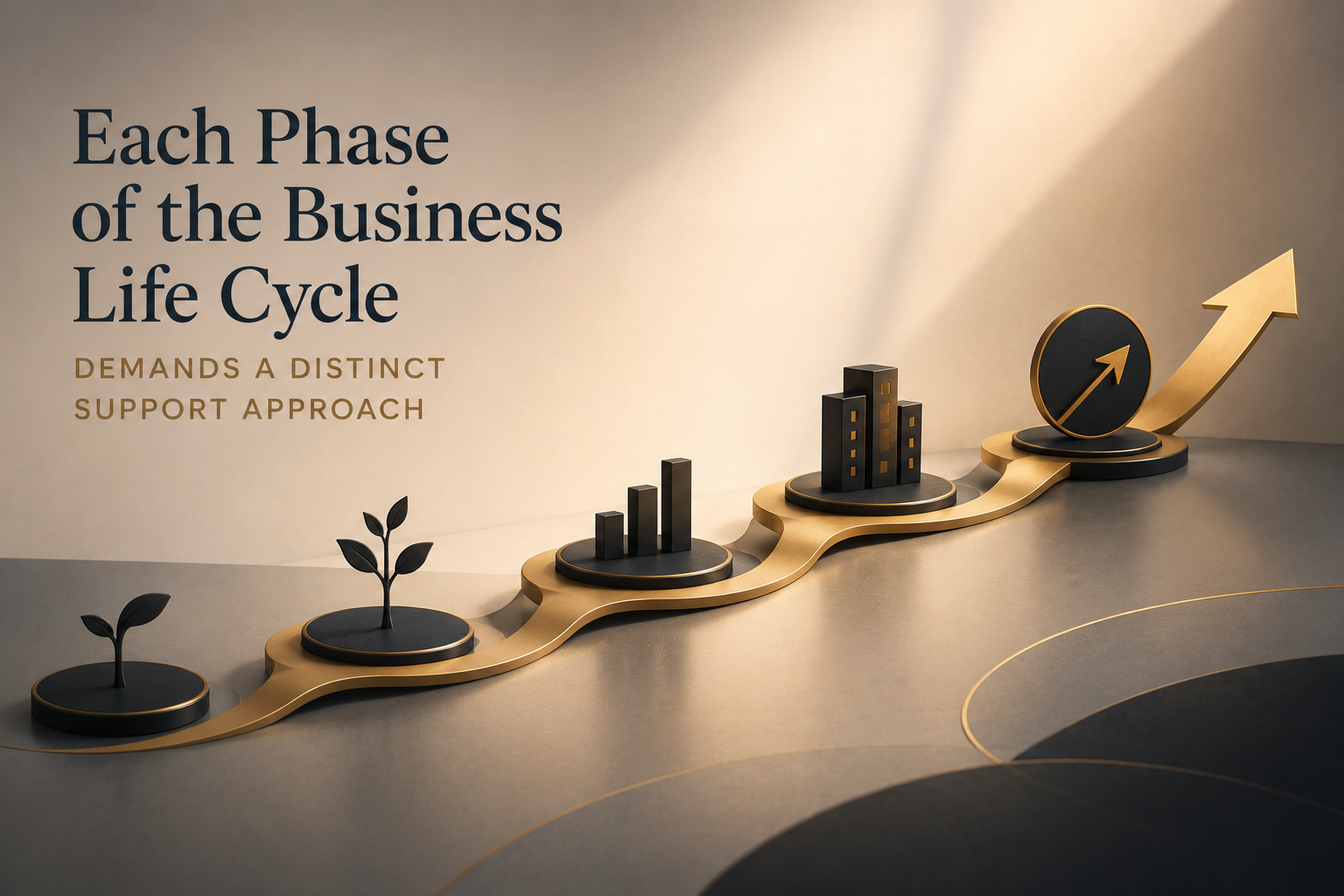
Businesses at different stages of development face different strategic, operational and capability requirements. This article examines why enterprise support should move beyond generic interventions towards stage-responsive support that reflects the needs of start-up, growing, established, mature and declining businesses.
Written: 8 February 2025
Small and medium enterprises play an important role in economic development, employment creation and innovation. In South Africa, considerable public resources and institutional mechanisms have been established to support entrepreneurs and small businesses. Yet persistent business failure raises an important question: is enterprise support sufficiently aligned with what businesses actually need at different stages of their development?
The establishment of the Small Enterprise Development and Finance Agency (Sedfa), which commenced operations on 1 October 2024, represented an important development in South Africa's enterprise-support ecosystem. Sedfa consolidated the Small Enterprise Finance Agency (SEFA), the Small Enterprise Development Agency (SEDA) and the Cooperative Banks Development Agency (CBDA), bringing financial and non-financial enterprise support within a more integrated institutional arrangement.
This development recognised an important reality: enterprises require more than access to finance. They may also require business assessment, technology and systems support, infrastructure facilitation, market linkages, supply-chain integration and other forms of capability development.
However, strengthening the institutions that provide enterprise support does not, on its own, resolve a more fundamental challenge: businesses do not all require the same support.
Research on South African SMMEs has identified persistent constraints including limited access to finance, inadequate support structures, insufficient industry experience, market-access barriers, infrastructure deficiencies, regulatory challenges and gaps in business and management capability. These challenges do not necessarily arise simultaneously or affect every enterprise in the same way.
The stage of the business matters.
A start-up attempting to establish its market and operating model faces fundamentally different requirements from an established enterprise seeking greater efficiency, innovation or market expansion. Similarly, a mature enterprise confronting stagnation requires different interventions from a business experiencing decline and requiring restructuring or turnaround support.
Enterprise development should therefore move beyond generic support towards stage-responsive support.
Start-up Phase
At the start-up stage, the priority is establishing a viable foundation for the enterprise. Support may include business planning and strategy development, market research and validation, access to appropriate financing, mentorship and advisory support, and the development of relevant networks and market relationships.
Growth Phase
As an enterprise grows, the challenge shifts from establishing the business to building the capacity required to sustain expansion. Support may therefore focus on scaling operations, strengthening management systems, developing marketing and sales capabilities, accessing appropriate talent, improving supply-chain arrangements, and strengthening financial management and planning.
Established Phase
An established business may require support that strengthens competitiveness and long-term institutional capability. This can include strategic review, market and competitive analysis, operational improvement, innovation and product development, leadership development, and succession planning.
Maturity Phase
At maturity, maintaining relevance becomes increasingly important. Businesses may need to diversify markets, innovate products and services, improve operational efficiency, retain critical talent, and develop strategic partnerships and collaborations that create new pathways for growth.
Decline Phase
Decline should not automatically be understood as the end of an enterprise. Where the underlying business remains viable, timely intervention may create opportunities for renewal. Support at this stage may include turnaround strategy, restructuring and reorganisation, operational and cost review, market analysis, competitive repositioning and appropriate financial interventions.
From Enterprise Support to Enterprise Capability
The effectiveness of enterprise development should ultimately be assessed not simply by whether support was provided, but by whether that support strengthened the enterprise's ability to operate, adapt, compete and grow.
This requires understanding the enterprise before prescribing an intervention.
Financial support may be necessary but insufficient where the underlying constraint is weak governance, limited leadership capability, an unsuitable operating model, inadequate market access or insufficient organisational capacity. Likewise, training alone will have limited impact if it does not address the actual capability requirements of the enterprise.
A more effective enterprise-support ecosystem therefore requires diagnosis before intervention and differentiation rather than standardisation.
When support is aligned with the stage, circumstances and capability requirements of an enterprise, it becomes more than assistance. It becomes an instrument for strengthening businesses that are better equipped to navigate change, create value, sustain employment and contribute to economic development.