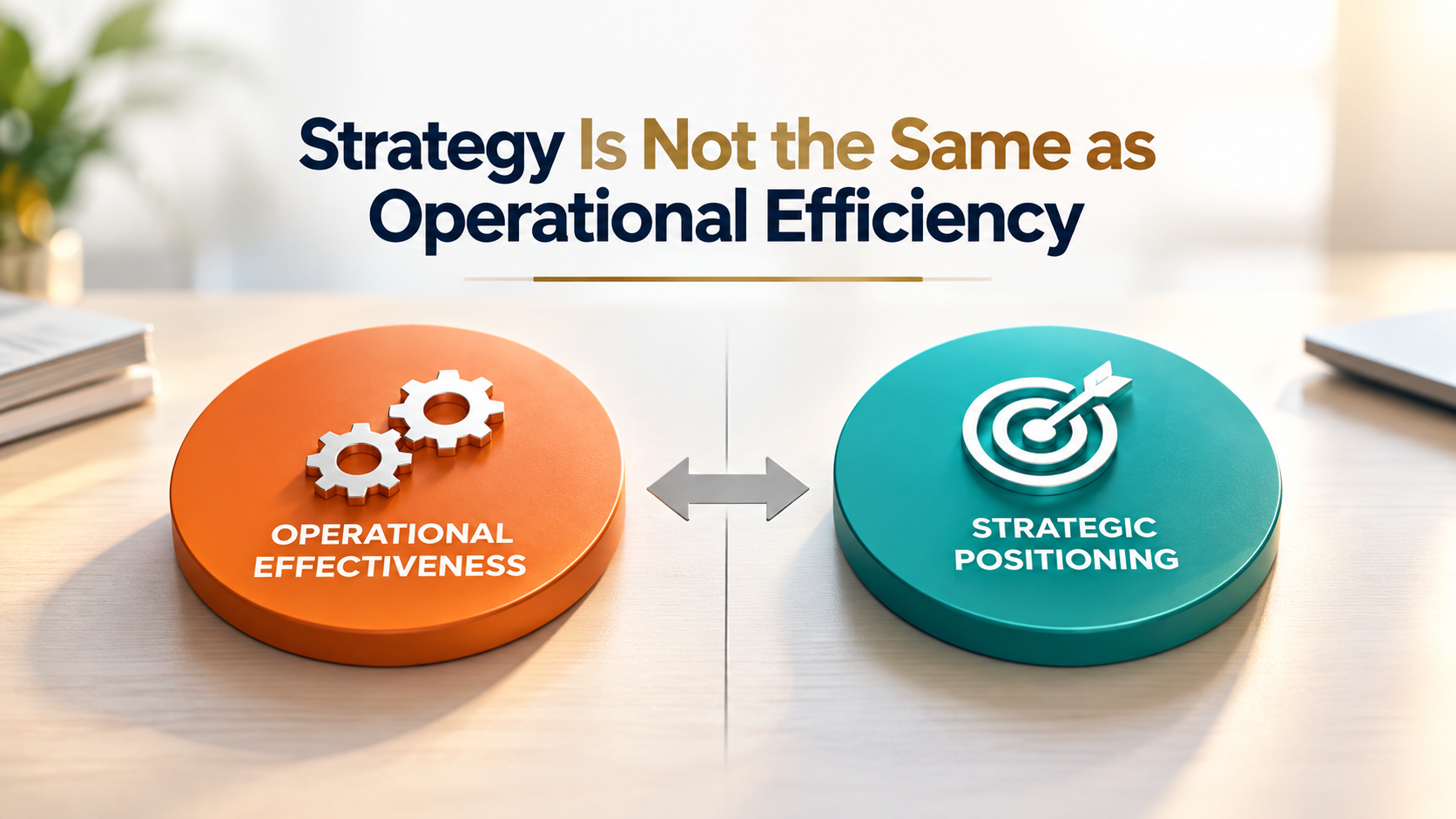
Operational effectiveness and strategy both contribute to business performance, but they serve different purposes. Operational effectiveness focuses on performing activities better through improvements in productivity, quality and efficiency, while strategic positioning requires distinctive choices about how an enterprise will create and deliver value. This article examines why businesses need both operational capability and strategic differentiation to strengthen performance and sustain competitive advantage.
Written: 16 February 2025
Businesses continually seek ways to improve performance. They streamline processes, adopt technology, benchmark competitors, outsource activities, reduce costs and improve productivity. These improvements matter, but improving how efficiently a business operates is not the same as having a strategy.
Porter (1996) describes operational effectiveness as performing similar activities better than competitors. It includes practices that enable an organisation to use its resources more effectively, improve quality, increase productivity or reduce the time and cost associated with delivering products and services.
Operational effectiveness is therefore important. The distinction lies in what it achieves. While operational effectiveness focuses on improving the performance of activities, strategic positioning requires an organisation to make distinctive choices about how it will create and deliver value.
Table 0.1 summarises this distinction between operational effectiveness and strategic positioning.
Table 0.1: Operational Effectiveness vs. Strategic Positioning
| Operational Effectiveness | Strategic Positioning |
|---|---|
| Performing similar activities better | Performing different activities, or similar activities differently |
| Improves productivity, quality and efficiency | Creates a distinctive value proposition and position |
| Best practices can often be imitated | Requires deliberate choices and trade-offs |
| Strengthens execution | Establishes strategic differentiation |
Adapted from Porter (1996).
Why Operational Effectiveness Is Not Enough
Operational improvements can strengthen performance, but competitors can often adopt similar practices.
Businesses can benchmark one another, acquire similar technologies, use the same suppliers and professional services, adopt comparable management practices and replicate process improvements. As competitors progressively adopt similar approaches, improvements that initially created an advantage can become common practice across an industry.
Porter (1996) describes this as competitive convergence: organisations become increasingly similar as they pursue the same practices and improvements.
The implication is not that businesses should stop improving their operations. Operational effectiveness remains necessary. It is simply insufficient as a substitute for strategy.
Strategy Requires Distinctive Choices
An enterprise must consider not only how well it performs its activities, but also the choices that determine its positioning and the distinctive value it intends to create.
This requires businesses to move beyond asking:
How can we perform this activity better?
They must also consider:
What should we do differently, where should we focus, and what distinctive value should we create?
The distinction matters because an enterprise can be highly efficient at performing activities without establishing a meaningful competitive position.
Porter (1996) argues that sustainable strategic positioning depends on creating a distinctive configuration of activities and making choices about what the organisation will and will not do. Strategic positioning therefore requires coherence between the organisation's choices, activities and the value it intends to create.
Capabilities Must Support Strategic Positioning
The organisation's internal resources and capabilities are also important to this distinction.
Grant (2008) highlights the increasing importance of firm resources and capabilities in understanding competitive advantage and strategy formulation. Organisations differ in their knowledge, expertise, relationships, systems, technologies and other capabilities. These differences influence what they are able to do particularly well and how they can create distinctive value.
However, capabilities become strategically significant when they support the organisation's chosen position and direction. Developing capabilities without clarity about their strategic purpose can result in substantial operational improvement without corresponding strategic advantage.
The relationship is therefore important: strategic positioning determines where and how the organisation intends to create distinctive value, while operational effectiveness and organisational capabilities strengthen its ability to deliver that value.
Businesses Need Both
The distinction between strategy and operational effectiveness should not create a false choice between the two.
A business with a distinctive strategic position but weak operations may struggle to deliver consistently. Equally, a highly efficient business without strategic differentiation may perform well operationally while remaining vulnerable to competitors pursuing similar approaches.
Sustainable performance therefore requires both strategic clarity and operational capability.
At Goshen Business and Career Advisory Services, we recognise this distinction in our Business Advisory approach. Enterprises need clarity about their strategic positioning and priorities while also developing the capabilities, systems and operating requirements necessary to execute those choices effectively.
Operational effectiveness strengthens how well an enterprise performs. Strategic positioning determines the distinctive choices that give those activities direction and purpose. Strong enterprises understand the difference and align the two.